


'For Flight's Sake'
The Threat of Absence
Labor Day at the Skyport, 1960s.
IHM 2001.017.019.
Turbulent Times
Anchor link copied.
The new landowners attempted to terminate Linn Emrich's lease early. That decision launched a domino effect of sorts, as Emrich would go to court several more times over the next seven to eight years, prolonging its closure little by little. Jamey Woodward, who ran the site's Parachute Center, would also fight eviction.
Development of the project went to Langly Associates, a development company. Lang Sligh was the primary contact for this project, and indeed his name comes up countless times in newspaper articles surrounding the Skyport.
From the moment the airfield's existence was questioned, community members were in an uproar; some could not imagine life in Issaquah without it, while others had been ready for it to dissolve for years.


Left: Linn Emrich. IHM Collection, 2013-003-855.
Right: Lang Sligh.
They fought a years-long court battle over the Skyport land.

"Just by being residents, all of us have the thrill of being a part of the Air Shows staged here each summer. Starting 11 years ago, the Sky Circus has filled the air around us, without much effort on our part making us one with this unusual spectator sport. And even on every sunlit evening, a few colorful parachutes and gliders liven our atmosphere, giving a lift to that unique 'Issaquah Feeling', now provided to all residents.
But how long will we be able to keep it to enjoy, if we do not verbally express our desire to keep it—and our way of life in this valley?"
—Harriet Fish, Issaquah resident & historian, May 1982
Gliders trace quiet arcs, 1970s.
IHM 2001-017-021.
Hearing Both Sides
Anchor link copied.
The graphic below shows the main arguments for saving or paving the Skyport.
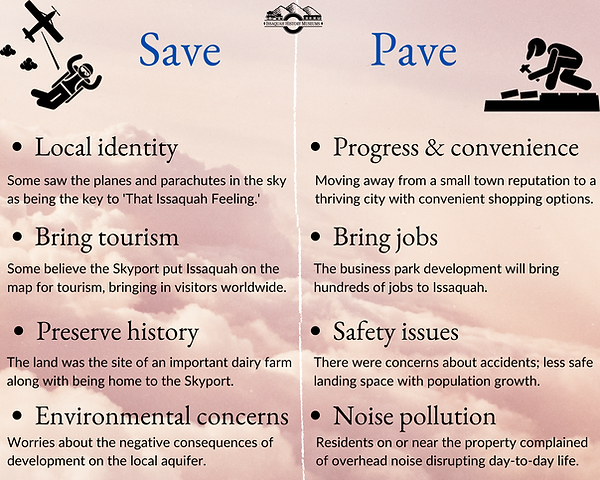
These are only the main points of contention concerning the Skyport; countless additional points were brought up at public forums, fundraisers, and more.
"[...] it was tough because you had public sentiment on one side for the Skyport, which was lovely—parachutes flying from the air. And then on the other hand, you had the property owner saying, 'I want my land back.' And then there was another issue, was a safety issue."
—Marilyn Batura, longtime Issaquah resident &
former City Councilmember
Letters from the Community
Anchor link copied.
Individuals of all ages took action to keep the Skyport alive. Small businesses banded together to send letters to City Council. Similarly, people on both sides attended public hearings to make their voices heard.


These are only a small batch of public hearing minutes and letters from the community regarding the Skyport.
Top left: 1986 hearing minutes (Linn Emrich is speaker 24).
Top right: A 1987 letter from a local nine-year-old. IHM 2008.028.004a,b.
Middle: An illustrated letter describing the Skyport as central to Issaquah's image. IHM 2010.007.212.
Bottom: A small business letter on Skyport tourism; many similar petitions are in the collection. IHM 2010.007.202
The Solution
Anchor link copied.
It quickly became clear just how divisive of an issue the Skyport was. After numerous City Council meetings and public hearings, the people of Issaquah were given options to determine the airfield's fate via the town's first ever mail-in voting ballot. In order to save the Skyport from erasure and commercialization, two measures would have to pass with a YES vote:
-
Measure 1: Do you wish to form a Park and Recreational Service Area? (needs a simple majority to pass)
-
Measure 2: Do you wish to buy the Skyport with a $5.2 million bond? (needs a 60% majority to pass)
If both measures did not pass with a yes vote, the Skyport would have to shut down operations and the property would get prepared for retail development.
Rallying for the Vote
Anchor link copied.
Once the measures were set and the voting guidelines were clear, the community set out to inform each other on the benefits of a yes and a no. The primary groups were called "Skyport Solution" and "Citizens Against Skyport."
Both sides wrote in to newspapers to express their opinions and encourage the community to consider the issue from different points of view, including the developer's. Pro-Skyport citizens were particularly active, hosting fundraisers, sending out brochures, forming groups, and even writing songs to garner as much support as possible.
The song in the video above captures what was so special about the Skyport for those who loved it. "It's a part of what makes Issaquah such a special place to be," they sing, further strengthening the tie between Issaquah's identity and the Skyport. It would have been played on the radio to remind voters to vote yes-yes on the upcoming ballot.

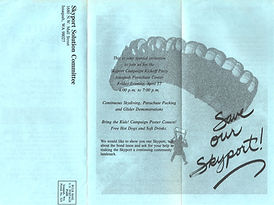

Top:
May 1, 1987: Skyport bond ballots arrive as "Skyport YES!" supporters watch.
IHM 2004-039-294.
Bottom left:
"Save our Skyport!" brochure.
IHM 2008-028-003a-c.
Bottom right:
A "NO!" sign which opposed the airfield remaining in town.
IHM 2003-033-122.
The Results
Anchor link copied.
All of the votes were counted by May 29, 1987. Voters approved measure 1 to form a Park and Recreational Service Area (5,291 for; 3,730 against). Measure 2, which would allow the Skyport to remain, needed a 60% majority; it barely failed with 55% of voters wanting to pay to keep the airfield.

Accepting Defeat
Anchor link copied.
This opinion was submitted to the Issaquah Press just after the final votes were tallied. It expresses a desire to move on from the issue, notably adding that the fight for the Skyport "was done with the greatest amount of participation that has ever been afforded in any election in the Issaquah area." Similar sentiments flooded the newspapers, encouraging residents to find other community institutions to support, and reassuring them that they would find a new sense of identity.
This level of community engagement demonstrates just how strong the feelings surrounding the Skyport were, along with its importance to Issaquah's history.
With that, the voters of Issaquah spoke. The 5% margin was incredibly close, but simply not enough; the Skyport would need to leave within about a month.

A view of the Skyport field from beneath a plane. IHM 2002-031-001.
Continue on to the final chapter of this exhibit to learn how Issaquahans coped with the Skyport closing; where Emrich and Woodward went next; and what now defines Issaquah's visual identity.
