


'That Issaquah Feeling'
How the Skyport Became the Image of Issaquah
Gary Lundstrom on his first parachute dive over Skyport, with I-90 and Lake Sammamish Park in view, 1980. IHM: 2011.010.002.
Various Operations at the Site
Anchor link copied.
The site changed hands several times over the years, but it remained a flight facility in some capacity from about 1940–1987.
A condensed visual timeline is available at the bottom of this page.
1. The Department of the Navy
Anchor link copied.
As a flat pasture nestled in the valley, the land in question made for an excellent airfield location. Around 1940-41, the Department of the Navy approached Rob Pickering, then-owner of the land in question, one of the largest dairy farms in the area. The Navy told Pickering they needed to use the land for flight training for pilots flying out of the Naval Station Puget Sound in Seattle's Sand Point.
2. Ab Davies, Al Lockwood & the Seattle Sky Ranch
Anchor link copied.
Pilots Ab Davies and Al Lockwood teamed up to use the property as a flight training school for soldiers using their G.I. Bills (funding for soldiers to get the education they choose). They called it the Seattle Sky Ranch. At one point, it was the biggest flight training facility in the entire state, training about 125 men per month. They shut operations down in about 1955 due to increased rent and the G.I. Bill window coming to a close.
Shortly after it closed, pilot Art Banko took over management of the field for use as a private landing strip.

Ab Davies with his wife, Marjorie. IHM 2005.004.001.

The site of the airfield in September 1945, right around when Ab Davies and Al Lockwood's operation began. This view looks north and is likely similar to what it would have looked like when the Navy was there. Photo used with permission from Paul Freeman of airfieldsfreeman.com. IHM: 2005.004.001.

Tableware from the Sky Ranch Cafe/Tavern. The restaurant was quite popular during the late 1940s through the 1950s, eventually shutting down by 1963 when the next owner used the building as a jump clubhouse. (We do not currently have any images of the restaurant; if you do, please get in touch! We would be elated to have them in our collection.) IHM: 2015.014.037, 2015.014.030.
3. Linn Emrich & The Skyport
Anchor link copied.

Linn Emrich holding a seagull, c. 1970.
From Linn Emrich's scrapbook. IHM 2001.017.027.
Pilot Linn Emrich (1931–2002) leased the Pickering property in 1961. Emrich was known to be fascinated with flight as a whole—not only aircrafts, but birds as well. Born in Harvey, Illinois, his family moved to Mercer Island when he was a child, later moving to Issaquah. He got a Bachelor's Degree in Psychology from the University of Washington, but his professional life remained focused on flight; he served in the U.S. Air Force, worked as a flight engineer for Pacific Northern & Pan American Airlines, and was a co-pilot for Alaska Airlines.
Emrich was fiercely passionate about the recreational airfield, and his drive and charisma were really at the heart of the Skyport's rise to iconic status. His mission was "to encourage the use of the sky as a playground, with courage, safety, good sportsmanship, and healthy competitive interests."
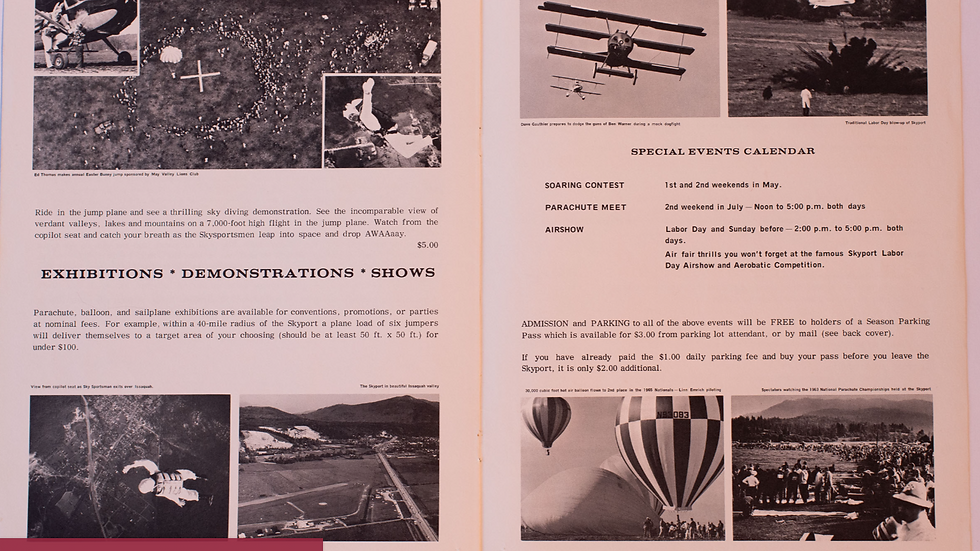
At the Skyport, you could learn to soar, jump, and perform aerobatics. You could also ride in a jump plane and watch the "Skysportsmen" leap out. Towplanes and gliders were a regular pair on the grass runway. Private pilots could use the airfield only if vetted by Emrich himself. The Skyport boasted hot air balloon, parachuting, and sailplane exhibitions. There were plenty of additional exhilarating activities, ranging from Easter bunny jumps; the Parachute Championships; mock dog fights (including the Red Baron vs. Snoopy); the Lan Roberts Sky Circus in 1970; and much more.
Being such an active airfield, it was commonplace for residents to see parachutes drifting down, along with gliders floating through the valley. Images like these became part of the fabric of daily life in Issaquah; people both in and out of town came to see the Skyport as the area's defining iconic feature.

A pair of jumping boots used at the Skyport.
IHM FIC.2005.093.
Within just two years of opening the Skyport, Emrich hosted the National Parachute Championships at the site. It aired on national television and attracted hundreds, if not thousands of spectators. It is argued that this event put Issaquah on the map for tourism.

Detail of a contact sheet which demonstrates the popularity of Skyport events, c. 1973. IHM 2001.017.026.


Left: 1963 National Parachute Championships poster, 1963. IHM 2002.007.001.
Top right: Detail of a parachute used at the Skyport, c. 1976. IHM 2005.037.003.
Bottom left: Undated image of an unidentified parachutist. IHM 2002.041.549.
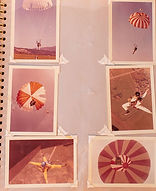
Bottom right: Undated images from Linn Emrich's personal Skyport scrapbook, 1960–1979. IHM 2001.017.027.
See the Skyport activity in action! Video courtesy of the University of Washington Special Collections Library. (no audio)
This undated contact sheet (likely sometime in the 1960s or early '70s) demonstrates the large crowds that flocked to the Skyport to watch the fun.
IHM 2001.017.026.
The Issaquah Parachute Center
Anchor link copied.
The Skyport site also hosted a dedicated Parachute Center, ran by Jamey Woodward (left). He began his operation in the late 1970s as a subtenant under Linn Emrich. Woodward, like Emrich, was extremely passionate about sky sports and would go on to fight its closure until the very last day it was open.


Jamey Woodward, c. 1980. IHM 2013.003.1660.
A t-shirt from the Issaquah Parachute Center. Photo courtesy of Robin Kelley.


Left: Pilot Thomas Curran in a Pawnee plane, which he used to tow glider planes, c. 1982.
Right: Pawnee airstrip view over I-90 and Issaquah, looking northwest to Lake Sammamish, c. 1982.
Both photographs courtesy of Thomas Curran.
A Place With Many Names
Anchor link copied.
The Skyport land was recognized by several names over the nearly 50 years it existed:
-
The Seattle Sky Ranch
-
Seattle Sky Sports (Club)
-
Sky Ranch Airport
-
Issaquah Airport
-
Issaquah Airfield
-
Issaquah Sky Sports
-
Seattle Sport Parachuting Center
-
Issaquah Parachute Center
Chances are, if you said any of these to a local at the time, they would know the place you were talking about.

The SkyRanch Labor Day Float, celebrating Issaquah’s aviation heritage and the iconic Skyport that shaped a generation. IHM 2004.011.106.
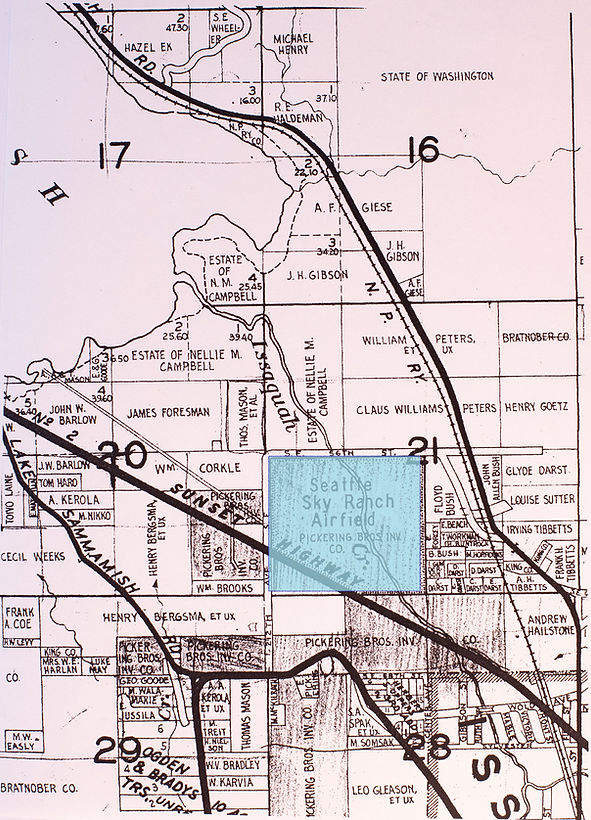
This cropped map (c.1945–1955) is in Linn Emrich's personal Skyport scrapbook, generously donated to the Issaquah History Museums in 2001. The Skyport plot is highlighted in blue. IHM 2001.017.027.
Trouble in Paradise
Anchor link copied.
The Skyport was nationally recognized as a quality training center with some of the highest safety standards (i.e. planes thoroughly checked every 100 hours) and top-notch equipment. However, despite everyone's best efforts, a few accidents did occur there. One of the most hard-hitting for Emrich was in 1973, when a Cessna 170 crashed just a few hundred yards away from the Skyport runway and killed all five people aboard. The plane had just been inspected and cleared for flight, and Emrich could not make sense of the tragedy. He closed the Skyport for a couple of weeks to take time to reflect and recoup.
In 1975, part of the Pickering property, including the Skyport area, was sold to a real estate company. The company was eager to get the land developed, even before Emrich's lease was officially over. By this time, the Skyport had been around for about 15 years and was widely beloved by Issaquahans and visitors alike. As we know, Emrich loved this airfield, and was not going to let it go without a fight.

Click the timeline to open a screen-fitted view, then enlarge if needed. Some dates are only approximate, such as when the Navy took over the field; some accounts claim it began in 1939, while others say 1940-41. Additionally, some sources claim that Davies & Lockwood began the Sky Ranch as early as 1941, but others say 1945 as that is when soldiers could use the G.I. Bill to attend their flight school. Emrich's legal battles may have actually started in 1978.

Extra: The Skyport & D.B. Cooper
Anchor link copied.
On November 24, 1971, the infamous “D.B. Cooper” hijacked Flight 305 from Portland to Seattle, claiming he would set off a bomb if his demands were not met. Along with his infamous ransom of $200,000 in $20 bills, another demand was that he get four parachutes specifically from the Issaquah Skyport.
Linn Emrich got the call and sent the packs off to be delivered at Sea-Tac Airport (although he only sent two chest pack chutes, while a Renton firm supplied two backpack chutes). According to this December 1, 1971 Issaquah Press issue, he had a hunch as to who D.B. Cooper was, and indeed the FBI 'hounded' Emrich (misspelled in the background article) for so long that he and his family decided to take a vacation. It is suspected that, since he demanded chutes specifically from the Skyport, the hijacker may have frequented the recreational airfield.
Cooper was never caught. 45 years later, in 2016, the FBI released a statement saying they had “redirected resources allocated to the D.B. Cooper case to focus on other investigative priorities.”

Left: Linn Emrich examines a chest pack chute similar to one he sent with authorities to appease D.B. Cooper.
Right: A chest pack chute used at the Skyport which was donated to the Issaquah History Museums in 2005.
