


Poetry in Motion:
Remembering the Issaquah Skyport
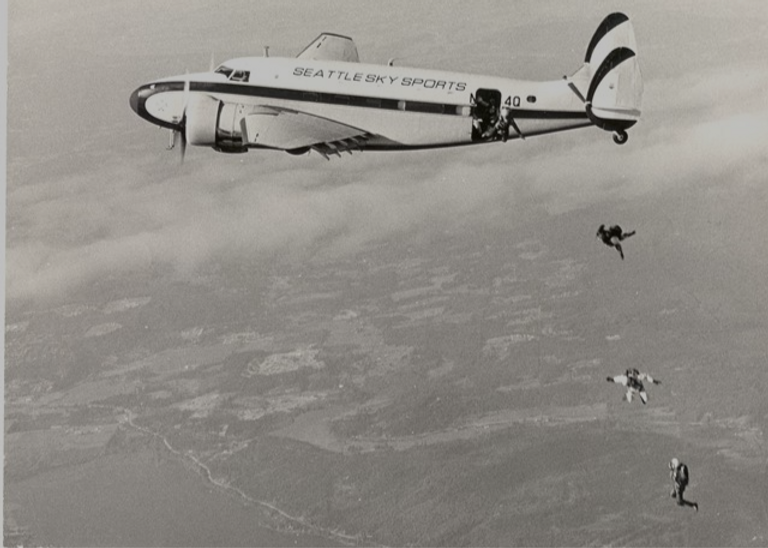
Jumpers Exiting Seattle Sky Sports' Lockheed Lodestar, c. 1973.
IHM 2001.017.017.

Issaquah
Anchor link copied.
Issaquah, Washington, is a city 15 miles (24 kilometers) southeast of Seattle. Part of Issaquah’s recent history includes becoming home to Costco’s world headquarters. But what was there before? Just seven years prior to the wholesale store opening its doors in 1994, the land just west of today's warehouse was used as a recreational airfield called the Issaquah Skyport, and had been used for flight purposes since the early 1940s.
Background: View of Costco building, c. 1990.
IHM 2013.003.709.
The Exhibit
Anchor link copied.
This exhibit revolves around the Issaquah Skyport. Beyond that narrative lies a complex and important history of land use and ownership, along with all of the emotional connections we humans make with places around us, whether or not they still exist as they once did.

The Purpose of Place
Anchor link copied.
Places are key in molding an individual, a community, a nation’s identity. For example, the Eiffel Tower has become synonymous with France; the Space Needle with Seattle. Whether a monument, a building, a particular tree, your favorite coffee shop nook—these are all things that nestle themselves in our minds and form a direct link with our sense of a given place. Usually, sites like these imply some sense of stability—you can count on them being there. But what happens when we lose a place that was once considered the defining feature of a town?
Issaquah Skyport T‑shirt, a wearable reminder of the landmark that once defined the town’s sense of place. IHM 2002.044.001.
History tells us that meaningful places are stolen, burned to the ground, or repurposed all the time, but the fact that landscapes are subject to flux due to human agency arguably makes it more important to explore the meanings they once held. Keep this in mind as you explore the exhibit and learn all the ways the Skyport was meaningful to some, and a nuisance to others.
Community is really at the heart of this topic, which is why we interviewed individuals who saw the Skyport in action, be it as a spectator, participant, or pilot. We thank these community members who have helped inform our understanding of the Skyport and what it meant to those who encountered it: David Anderson, Thomas Curran, Robin Kelley, and Tricia Tamura.
Look for buttons at the bottom of each page to navigate between chapters:
Chapter 1: The Introduction sets the stage for the exhibit, discussing the meaning of the land used for the Skyport operation.
Chapter 2: That Issaquah Feeling chronicles the heyday of the Skyport, including its various names, games, and operations. Plus: learn about the Skyport's connection with the unsolved mystery of D.B. Cooper.
Chapter 3: For Flight’s Sake dives into the heated battle between residents on whether to save the Skyport or pave it in favor of a business park, accompanied by a visual timeline at the end.
Chapter 4: What Remains explores the local impact of the loss of this iconic airfield: How do we grow to be so attached to a location? What happens when we lose an important site? What defines Issaquah in the Skyport's absence?

Parachute participant viewed from below, c. 1970. From Linn Emrich's scrapbook. IHM 2001.017.027.

This virtual exhibit was made possible thanks to a grant from the City of Issaquah's Arts Commission and the work of 2026 volunteer Lilian Wang.